My Honest Take on the Coding Agent Landscape
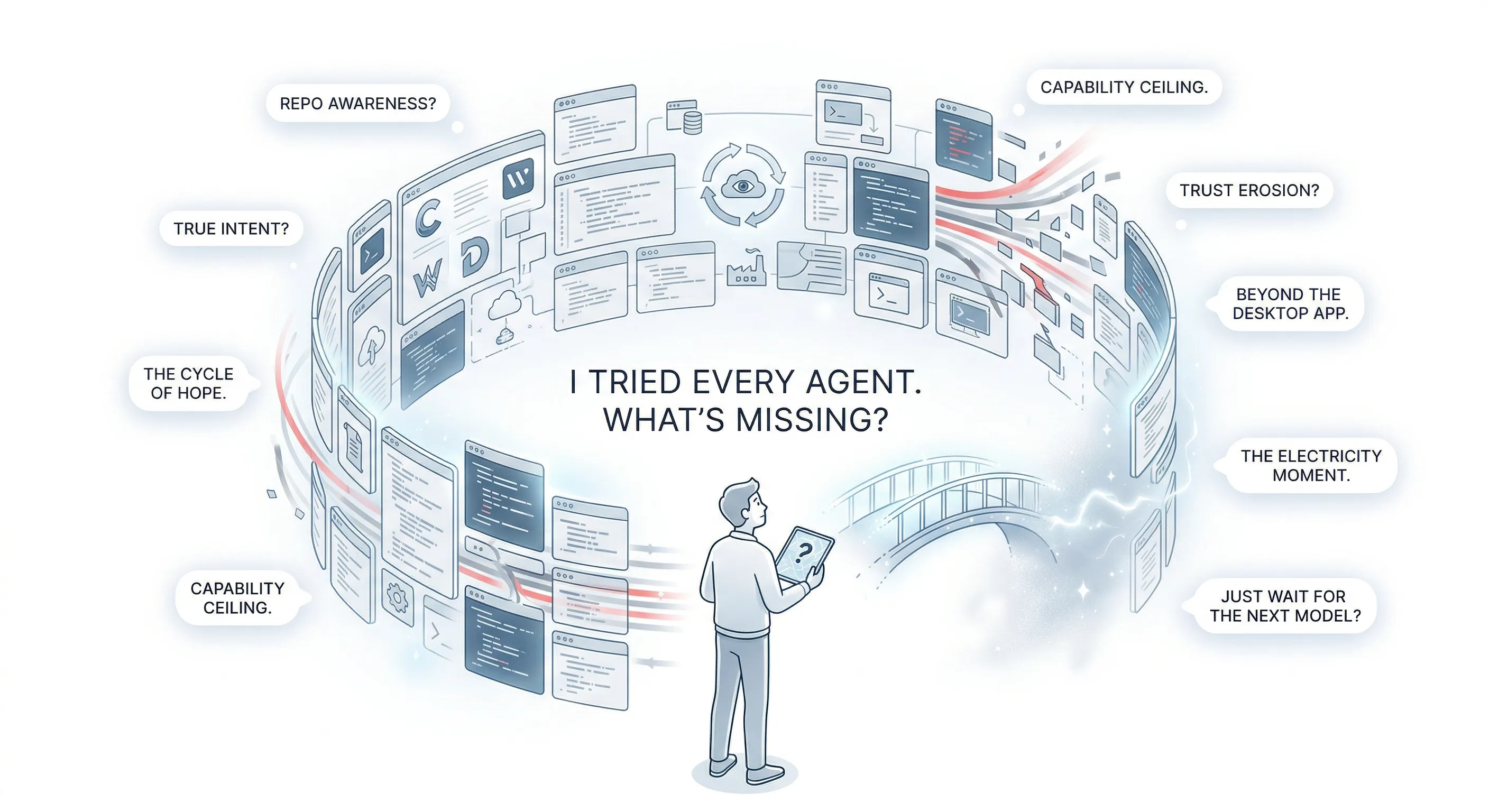
Here’s my honest take of the current coding agent landscape and why I’m still optimistic — genuinely optimistic, not just hedging.
I’ve tried Factory’s Droids, Cognition’s Devin, Claude Code, OpenCode, Github Copilot, Zed, Cursor, Windsurf, Augment Code, Codex, Ona, and probably the repo that you sent your friend that’s some cool new open source coding agent too. All the desktop apps, all the CLIs, cloud and local. The sheer amount of energy pouring into this space is remarkable.
At a certain point though, the features started to blend together. I follow the news cycle closely, and when I see headlines claiming a coding agent supports some feature for the first time, I think back to how several others shipped something similar months ago. I’d love to see more of that energy channeled into building for the engineer — not just the headline.
I Went Deep
I want to be clear — I didn’t just kick tires on twelve tools in a weekend. I spent real time with each one. I built workflows, wrote custom rules files, structured my context carefully. I know what a good AGENTS.md file looks like. I know how to scope tasks for agents. I know the best practice of keeping files small and modular so agents can reason about them. I did the work because I genuinely wanted each tool to succeed.
The ceiling I hit wasn’t a skill ceiling — it was a capability ceiling. And those are different things.
Being able to dispatch agents from my phone, in the cloud, locally — that part is genuinely exciting. The infrastructure is there. What’s lagging behind is the reliability to match it.
The Cycle
Can anyone else relate? You pick up a new coding tool, it’s working, you get excited — and that excitement is real. A week passes, your use case gets more complex, the tool starts faltering, you review the code — it’s not up to the bar — so you rewrite, modularize, start over. Then the cycle repeats. The code still wasn’t structured well enough for the agent to find consistent patterns, you see regressions, features that were working before aren’t anymore. It’s better than the first time — meaningfully better — but still not quite there. So you go back, write some code manually, course correct, then return to the agent.
Each pass is an improvement. But the gap between “this is amazing” and “I can trust this” is still wider than it should be.
”It Works Fine for Us at Scale”
Some teams genuinely have this working at scale, and that’s impressive. But it’s worth being honest about what “works” means in those setups. It usually means the team invested heavily in guardrails, CI pipelines, human review layers, and custom tooling around the agent. They built an entire support system to make the agent reliable. That’s a real achievement — and human oversight should always be part of the workflow. But right now, too much of that human effort goes toward catching things the agent should have gotten right on its own. The baseline reliability needs to be higher so that the human layer can focus on judgment calls, architecture decisions, and the things humans are actually best at — not babysitting output quality.
”The Problem Is Your Codebase”
There’s a fair counterpoint that better-structured codebases produce better agent results — more modular, better documented, smaller files, cleaner separation of concerns. And that’s probably true. But it raises a question worth sitting with: should the engineer restructure their codebase to accommodate the tool, or should the tool adapt to the codebase? That’s the whole promise. If I need to rewrite my architecture before the agent can be useful, the agent isn’t solving my problem — it’s creating a prerequisite to solving my problem. And that’s an opportunity for these tools to get dramatically better.
Stochastic Meets Deterministic
Here’s the deeper question: LLMs are naturally stochastic. Code needs to be deterministic. That’s not a false dichotomy — humans are stochastic too. We write bugs. We introduce regressions. We write messy code. But humans accumulate context over time. A human engineer who’s been in your codebase for six months doesn’t reinvent an implementation that already exists three files over. They don’t hallucinate a pattern that contradicts the architecture. The error types are different, and that matters.
It’s not about whether agents make mistakes — it’s about whether they make the kinds of mistakes that make it hard to build trust over time. And I think this is a solvable problem. If we can figure out how to give agents persistent, meaningful context — not just a snapshot of the repo, but real understanding — the gap between human and agent error patterns starts to close.
Is what we believe to be good code only taste, or is there something more to it that we can codify — something that lets us say this function was written well and this one was not?
The Harness Layer
So you build a harness and infrastructure. I built one called Atomic. It works really well for me — but I still face the problems above. I tweak the harness, add different tools, think about more problems. I want to be upfront: Atomic doesn’t fully solve it either. If it did I wouldn’t be writing this post. I’m sharing what I built because I think the harness layer matters and I want to be transparent about where I’m spending my time. The harness is where I’ve seen the most promising results, and I think it’s an underexplored part of the stack.
”Just Wait for the Next Model”
Will the next model generation solve all of this? It might close a big chunk of the gap — and every release genuinely does get better. But even so, I think the harness layer will still matter. It’s not a bet against model improvement — it’s a bet that even great models need structure. Even brilliant engineers need process. A better model inside a bad workflow still produces inconsistent results. If the next model generation makes harnesses obsolete, I’ll celebrate and move on. Until then, I’m building for the reality I have while staying ready for the one that’s coming.
What Are We Actually Building For?
What I actually want is straightforward: an agent that can work in my repo — more than 100k lines of code — without reinventing an implementation that already exists three files over. Without making up best practices. The potential is so clearly there, which is exactly why the gap is frustrating.
I have solutions in my head for this and I’ve been playing with them. They’re doing well but I’m tinkering early hours into the morning because I care about getting this right. I think there’s an opportunity for developer tools to meet engineers where they are — not behind a high bar of setup and configuration, but ready to go. We deserve tools that respect our time from the first session.
”That’s Just How Professional Tools Work”
It’s true that professional tools have learning curves. Kubernetes doesn’t just work. Terraform doesn’t just work. Git doesn’t just work. But those tools are deterministic. When I write a Terraform config and apply it, I know what’s going to happen. The learning curve is about understanding the system. With AI coding tools, the learning curve is about managing unpredictability. Those aren’t the same kind of hard, and recognizing the difference is how we design better experiences around these tools.
The Other Side
I love for something to just work. Not something I need to write scripts to start using or Terraform and create millions of templates for. Just something that works. And I think we’re closer to that than it might seem.
Something is missing on the experience side of the developer ecosystem and it’s not just another desktop app. It’s not just a better model either. It’s something in between. Something that actually knows your repo, not just indexes it. Something that respects the architecture that’s already there instead of proposing a new one every session. Something that understands every part of your environment and your functional intent. Something that makes week two feel as good as day one.
And when it works — when it really works — you know. I’m talking about the moment the agent does something genuinely intelligent. It understood what you were doing. It respected what was already there. It made a decision you would have made. And you feel it like electricity and you think holy shit this is it. I’ve had that moment. More than once.
We’re not there consistently yet. But I believe we will be — and the pace of progress tells me it’s not as far away as the frustrations might suggest. I see the other side, and it includes us. Not agents replacing engineers, but engineers and agents building together — where the human brings taste, intent, and judgment, and the agent brings speed, breadth, and tirelessness. I see the other side.
Huge respect to the engineers building these coding agents — what they’re doing is neither easy nor trivial, and every release moves the whole ecosystem forward. This post comes from wanting more for all of us, not less. The best way to honor the work being done is to stay honest about where we are and keep pushing toward where we’re going.
Stay in the loop
New posts delivered to your inbox. No spam, unsubscribe anytime.