Software Quality Has Never Been More Vulnerable
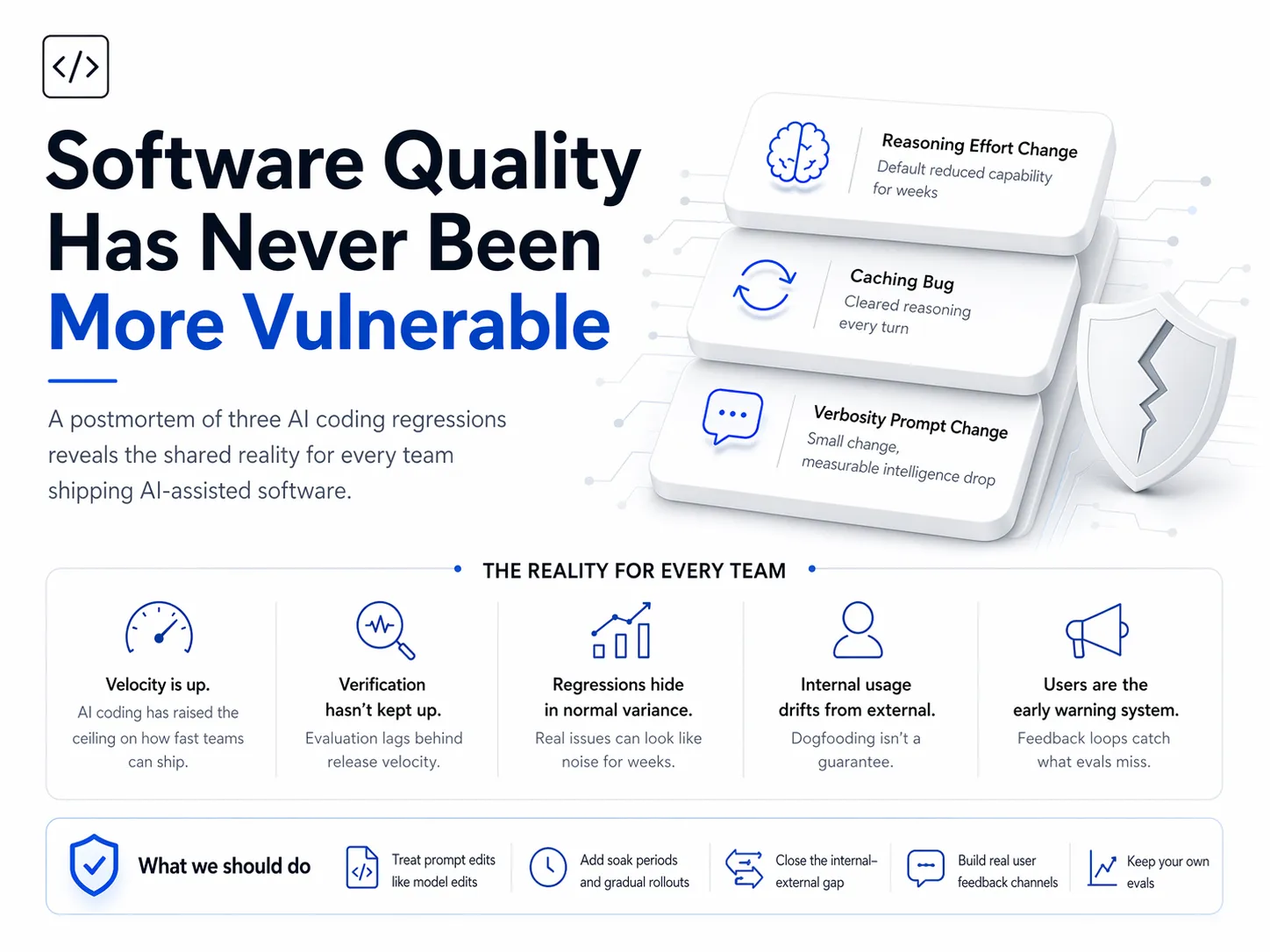
Anthropic published a postmortem yesterday[1]. The document was specific, technical, self-critical, and honest about what their full pre-release pipeline failed to catch. Three separate issues degraded Claude Code between March 4 and April 20. All three were fixed by v2.1.116 on April 20, and usage limits were reset for every subscriber on April 23.
But the document is also a mirror. The conditions it describes — continuous change across weights, prompts, scaffolds, and caches; evaluation coverage that trails release velocity; internal dogfooding that drifts from external usage; regressions that hide inside normal output variance for weeks — are not conditions unique to one lab or one product. They are the working conditions of the entire AI-assisted software industry right now.
We are in the era where AI coding has lifted the ceiling on how fast teams can ship, and we have not yet lifted the ceiling on how fast we can verify what we shipped. Software has never been more vulnerable than it is right now, and the Claude Code postmortem is the clearest public evidence we have of why.
What the postmortem actually covers
Three issues, stacked.
A reasoning-effort default change (March 4 – April 7). Claude Code’s default reasoning effort was switched from high to medium because high made the UI feel frozen. It was a reasonable tradeoff on paper — lower latency for tasks that didn’t need deep reasoning. In practice, users felt the capability drop immediately. The team reverted, and the current defaults are xhigh for Opus 4.7 and high for other models.
A caching bug that cleared reasoning every turn (March 26 – April 10). A prompt caching optimization for idle sessions shipped with a broken header flag. The clear_thinking_20251015 flag was meant to fire once. It fired every turn. The downstream effect was forgetfulness, repetition, and odd tool choices — exactly the pattern users reported. The issue was masked in internal usage by two unrelated concurrent experiments. It was eventually surfaced by back-testing Claude Code Review with Opus 4.7 against the offending pull request; Opus 4.6 had missed it. The fix shipped April 10.
A verbosity reduction in the system prompt (April 16 – April 20). The prompt added length limits on text between tool calls and on final responses. It passed weeks of eval runs. Broader ablations during the investigation revealed a flat 3% intelligence drop on both Opus 4.6 and 4.7 — small in isolation, real in aggregate. Reverted April 20.
The postmortem is explicit that each of these passed “multiple human and automated code reviews, as well as unit tests, end-to-end tests, automated verification, and dogfooding.” It is also explicit that users, via /feedback and public posts, were the mechanism that surfaced the problems at the speed they did.
All of that is in the document. Read it. It’s a good document.
The conditions the document describes are everyone’s conditions now
Here is the part of the postmortem that deserves more attention than the individual bugs.
Anthropic’s summary of why detection took time: “each change affected different traffic segments on different schedules. Early reports in March were difficult to distinguish from normal variation, and neither internal usage nor standard evals initially reproduced the issues.”
That is not a description of a broken process. It is a description of the operating environment that every AI-assisted software product now lives in.
Consider what shipped under the Claude Code surface in those six weeks — a reasoning effort default, a caching optimization, a system prompt edit. None of those are “model releases” in the traditional sense. They are small, continuous tuning knobs that are part of the product every AI-native team ships. And any one of them can independently introduce a regression that looks, to a user, like “the model got worse.”
Now generalize outward. Every team building on frontier models is continuously tuning prompts, swapping models, adjusting temperature and reasoning effort, reworking tool definitions, rebuilding RAG indices, editing agent scaffolds. Most of those teams have a small fraction of Anthropic’s eval infrastructure. Most of them have no /feedback channel, no dedicated developer relations account, no mechanism for surfacing regressions from users in hours.
The Claude Code postmortem is the rare case where the conditions of AI-native software development were written out in public. The conditions themselves are universal.
AI coding raised the ceiling on velocity. Verification didn’t follow.
The second thing to sit with is that AI-assisted development has changed how fast software can be produced, and this reshapes the risk profile of everything shipped with it.
A small team in 2026 can land work that would have taken ten engineers in 2022. Coding agents — Claude Code, Codex, Copilot, Cursor, the rest — produce real, shippable code at a throughput that makes the old cadence look obsolete. Labs use their own agents to accelerate their own pipelines; OpenAI’s latest release notes credit Codex with infrastructure optimizations on GPT-5.5 itself. The recursion is explicit. Frontier labs are writing more of their software with AI. Product teams are writing more of their software with AI. The ceiling on how much code gets shipped per week, everywhere, has moved up sharply.
What has not kept pace is the ability to verify the behavior of AI-powered systems at the same velocity. Traditional CI was built around the assumption that software is deterministic, that a green test suite means something stable, and that regressions are rare because the artifact is frozen between releases. None of those assumptions hold cleanly for LLM-powered products. The artifact is not frozen — it’s a live composition of weights, prompts, tools, and retrieval state. The tests don’t catch behavioral regressions that fall inside output variance. The regression is rare per change, but the change rate is extreme.
The gap between “how fast we can ship” and “how fast we can verify what we shipped” is larger today than at any point in the history of the industry. That gap is where vulnerability lives.
This isn’t a lab problem, it’s a paradigm problem
There is a tempting misreading of the postmortem that frames it as a story about Anthropic specifically — their process, their evals, their engineers. That’s the wrong frame, and it misses the more important point.
Every part of the document describes a structural condition that generalizes:
- Continuous tuning is now part of the product surface. The verbosity prompt is the clearest example. A single instruction about output length, inside a system prompt, caused a measurable intelligence drop invisible to standard evals. Every AI product team edits system prompts. Every one of them is one prompt change away from a similar effect.
- Output variance masks real regressions. “Difficult to distinguish from normal variation” is not an Anthropic phrase. It is the default state of every LLM-powered product. Noise is loud, and real drift hides inside it.
- Internal usage drifts from external. Staff at any AI lab, and at most AI-native product companies, run builds that are subtly different from what users see — early access to models, experimental flags, different rollout cohorts. “Dogfooding” as a guarantee gets weaker the further internal diverges from external.
- Users are now part of the evaluation loop. Not by choice, and not unique to Claude Code. The fastest regression-detection mechanism for almost every AI product in 2026 is a user noticing something felt off and having a channel to say so.
None of this is an indictment. It’s a description. The question worth asking isn’t “how did this happen at Anthropic.” It’s “given these are the conditions everywhere, what should responsible AI-assisted shipping look like?”
What this should change about how we ship
A few honest consequences if the framing above is right.
Treat prompt edits as model edits. The verbosity incident is the proof point. A prompt change is a capability change. If you’d gate a model swap behind a full eval suite, gate a prompt edit the same way. The per-model ablations Anthropic is committing to running on every system prompt change are a good template.
Budget soak periods into release cadence. Among Anthropic’s corrective actions: “soak periods, broader evaluation suites, and gradual rollouts to catch issues earlier.” The implicit admission is that the previous cadence didn’t leave room for them. Most AI product teams are in the same position, and many have far less room than Anthropic did.
Close the internal-to-external build gap, however you can. This is hard. Staff getting early access to new models is how labs and product teams move fast. But the further internal builds drift from external, the less your dogfooding tells you. One commitment from the postmortem worth copying: have the people who ship the software actually use the shipped software, in the same configuration users see.
Build a real user feedback path before you need one. A /feedback command, a dedicated community channel, a developer relations account that actually reads what’s posted — the Claude Code postmortem makes clear that these are not nice-to-haves. They are the primary mechanism by which real-world regressions get caught in hours instead of weeks. Most AI products don’t have this. The ones that will survive the next cycle of release velocity will.
For users: keep your own evals. If you’re running AI-assisted work that matters, do not rely on any provider’s internal quality bar to hold steady through continuous silent changes. Keep a small suite of your own tasks that you re-run periodically. You don’t need much — a handful of representative prompts that produce outputs you can compare over time is enough to notice drift early.
Closing
The Claude Code postmortem is a good document from a team that did the right thing in publishing it. The story it tells is not about one lab or one product. It’s about the working conditions of AI-assisted software development in 2026 — conditions under which everyone is shipping faster than anyone can verify, and real regressions routinely hide inside output variance for weeks before users surface them.
Software has never been more vulnerable than it is right now. Not because anyone is being careless. Because the ceiling on velocity moved up sharply and the ceiling on verification didn’t follow.
The labs are aware. Anthropic just wrote out in public what the condition looks like. The rest of the industry should read the document as a mirror, not a scoreboard, and act accordingly.
References
[1] Anthropic Engineering. “Claude Code quality issues: postmortem summary.” April 23, 2026. anthropic.com/engineering/april-23-postmortem
Stay in the loop
New posts delivered to your inbox. No spam, unsubscribe anytime.